
 Posted by
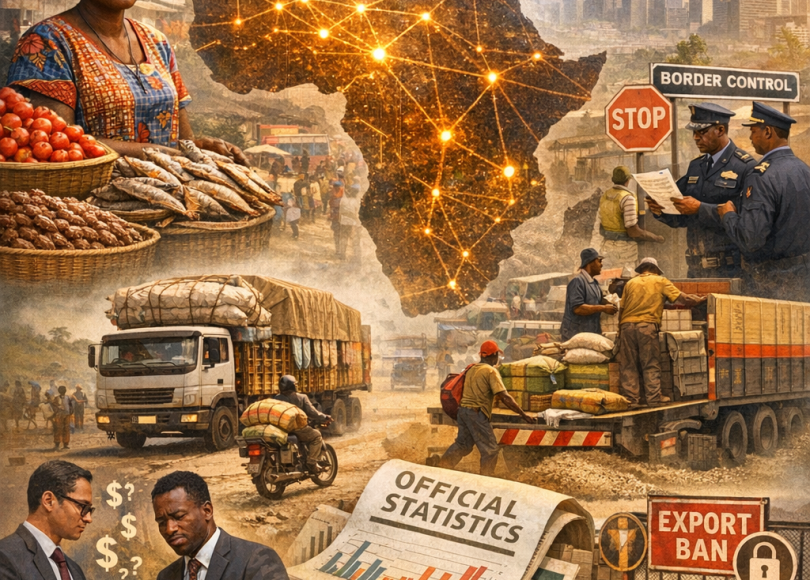
 You would not expect a small market town on the edge of the Sahel to sell much seafood. Yet Paga, in northern Ghana near the border with Burkina Faso, does exactly that. Adjoa al-Hassan stands behind piles of dried fish sourced from across West Africa. When supplies from Takoradi, Ghana’s coastal port, run thin, she and other market queens hire a lorry and travel north to Ouagadougou instead. The fish they buy may have come from Togo, Benin, or coastal Nigeria. What looks like a local stall is, in fact, the endpoint of a regional supply chain stretching thousands of kilometres inland from the Atlantic, as reported in The Economist.
For the traders involved, this is routine. For policymakers, it barely exists.
Across Africa, feeder towns sit between major commercial centres and the last mile, often extending beyond national borders. They are rarely destinations in their own right, but they quietly organise movement: goods pause, change hands, are repackaged, or are redirected across regions and countries. Transport operators, wholesalers, agents, and informal financiers cluster in these towns, forming dense cross-border networks that keep trade moving when formal systems fall short. Because they absorb shocks — shortages, price spikes, border closures, and poor roads — feeder towns often reveal more about how African economies actually function than capital cities ever will.
This gap between lived trade and recorded trade sits at the centre of one of Africa’s most persistent economic claims: that African countries trade far too little with one another. Official statistics place intra-African trade at roughly 15% of the continent’s total. The figure is endlessly repeated — in speeches, strategy documents, and donor presentations — as evidence of a broken regional economy still trapped in colonial trade patterns that link African exporters to distant markets while isolating neighbours from each other.
Correcting this imbalance is one of the core ambitions of the African Continental Free Trade Area (AfCFTA), which came into force five years ago. The African Union has tied the agreement explicitly to food security, calling for a 50% increase in food production and a tripling of intra-African agricultural trade over the next decade.
It is a great vision.
It is also built partly on a myth.
The Trade Africa Doesn’t See
Over the past decade, a growing body of research has shown that official trade statistics miss a vast share of Africa’s internal commerce — particularly food.
New work by the Sahel and West Africa Club of the OECD estimates that around $10bn worth of food is traded each year within West Africa alone, as much as six times higher than official figures suggest. When these unrecorded flows are added to reported data, the share of intra-regional trade in raw food (excluding cocoa and cashews) jumps from roughly one-third to nearly three-fifths — comparable to the European Union.
This is not a marginal correction. It fundamentally changes the numbers.
Africa’s food markets are not small, fragmented, or stagnant. They are already regional, adaptive, and surprisingly sophisticated. They are simply invisible to the systems used to measure them.
The same pattern appears beyond agriculture. A detailed study of Benin’s trade with Nigeria found that official statistics underestimated imports by 50% and exports by 85%. These were not just sacks of maize or tomatoes. They included industrial goods, textiles, and manufactured products.
Even the common image of “informal trade” as small-scale collapses under scrutiny. Nearly 90% of unrecorded food trade in West Africa involves large transactions moved by heavy lorries. Women selling tomatoes in Paga sometimes hire entire fleets to move produce across borders. Nearly half of Ghana’s trade with Africa is with countries it does not even share a border with.
African trade is not missing.
It is mismeasured.
When trade is mismeasured, the damage goes beyond bad statistics and seeps directly into policy. Governments misread scarcity, overreact to price movements, and intervene in ways that increase volatility rather than reduce it. Export bans seem sensible when trade appears thin, but reckless once its true density and adaptability are understood. Informal traders, missing from official data, struggle to access credit, while banks and insurers misprice risk, mistaking steady, diversified turnover for uncertainty. Investment in storage, processing, and transport is delayed because demand looks fragmented on paper when it is not in practice.
Why the Numbers Are So Wrong
The technical explanation is straightforward. Most African trade moves by road, not through ports. Customs systems were designed around maritime flows, formal documentation, and containerised cargo. Road-based trade, especially when it crosses borders daily through informal routes, overwhelms these systems.
Livestock traders rarely pass through official border posts. Truck drivers avoid checkpoints where delays, fees, and discretionary enforcement are costly. Attempts to count these flows tend to rely on sporadic surveys or extrapolations.
As Antoine Bouët, a senior economist at CEPII, has argued, attempts to measure informal cross-border trade using conventional customs data are often a disaster, not because the trade is small, but because the measurement tools were never designed for road-based, informal, and fragmented flows.
But stopping there misses the deeper issue.
This is not just a statistical problem. It is a policy design failure.
The tools used to measure trade assume a world of centralised control, clear documentation, and compliance by design. African food trade evolved in a very different environment — one defined by unreliable infrastructure, fragmented authority, and high transaction costs. The result is a system optimised for speed, trust, and redundancy rather than visibility.
And that distinction matters.
Because measurement does not merely observe reality. It reshapes it.
The Measurement Trap
There is an intuitive response to all this: if trade is happening, then governments should simply measure it better.
That instinct is understandable — and dangerous.
In practice, visibility can be problematic. When informal trade becomes visible, it does not simply become counted. It becomes regulated, licensed, taxed, inspected, delayed, and often constrained. The very attributes that make these markets work — flexibility, rapid adjustment, decentralisation — are the first to be squeezed out.
Digitisation is often presented as the solution. Yet in many African contexts it arrives as enforcement instead: more forms, more approvals, and more opportunities for rent extraction and corruption.
The paradox is uncomfortable:
The better governments see these markets, the worse they often perform.
This is not an accident.
Seeing vs Governing vs Controlling
Seeing trade is not the same as governing it. And governing it is not the same as controlling it.
Visibility can serve different purposes. Used well, it helps coordination — aligning transport, smoothing flows, reducing uncertainty. Used poorly, it becomes extraction — more permits, more inspections, more discretion. Too often, digitisation in African trade skips the first and accelerates the second.
This is why calls to “formalise” informal trade so often backfire. Visibility arrives before value. Traders are asked to comply before they receive anything in return: no faster clearance, no cheaper finance, no better infrastructure — just higher costs.
The result is predictable. Traders retreat further from the system. Trade does not disappear; it becomes harder to see and more expensive to move.
The problem is not measurement per se. It is measurement deployed as control rather than as coordination.
Who Benefits From Friction
African policymakers often frame weak regional integration as a coordination problem — something everyone wants, but no one quite manages.
That framing is simplistic.
In reality, many actors benefit from imperfect integration. Border congestion creates rents. Licensing systems reward insiders. Export bans generate arbitrage opportunities. Fragmented regulations protect domestic producers from regional competition while allowing political elites to allocate exemptions selectively.
When trade is slow, unclear, and dependent on discretion, power concentrates. When it is fast, predictable, and rules-based, power spreads.
This political economy helps explain why AfCFTA has progressed slowly where it matters most. Tariff reductions are relatively easy. They look good on paper and rarely threaten entrenched interests. Trade facilitation — harmonising standards, simplifying procedures, reducing discretion — is far harder.
As several scholars of West African trade, including Kate Meagher, have observed, state elites often benefit directly from the imperfections of regional integration.
The Counter-Argument: Informality Has Limits
There is a risk in pushing this argument too far.
Informal systems are not a cure-all. They work well at moving food across borders under normal conditions, but they do so by staying small enough to evade control. They struggle to support large-scale investment, long-term contracts, insurance, or credit. They are resilient, but not optimised.
When shocks hit simultaneously — climate events, conflict, macroeconomic crises — informal systems can amplify volatility rather than absorb it. They scale by replication, not coordination.
In other words, the choice is not between informality and formality. It is about sequencing.
And this is where policy repeatedly goes wrong.
When Policy Actively Undermines Trade
In the name of “food sovereignty”, many African governments have turned to protectionism.
Burkina Faso, Mali, and Niger — which exited ECOWAS in 2024 — have imposed restrictions forcing traders to source locally before importing food. Burkina Faso restricted shea-nut exports to support domestic processing, only to shut down factories in Ghana and Côte d’Ivoire that relied on those inputs. Benin imposed export restrictions on rice in 2022. Zambia blocked maize exports between 2024 and 2025.
These policies are politically popular. They signal control and national self-reliance.
They also weaken regional supply chains, increase price volatility, and undermine exactly the trade networks that cushion shocks. Food sovereignty pursued through isolation often produces the opposite of security.
What AfCFTA Actually Needs to Do
AfCFTA (African Continental Free Trade Area) was never meant to be a tariff agreement alone. Its real test is whether it can shift African trade policy away from control and toward flow.
That means focusing less on whether trade is formalised on paper and more on whether goods move faster, cheaper, and more predictably across borders.
If AfCFTA simply formalises today’s informal trade — adding compliance without reducing friction — it will shrink the markets it seeks to grow. If it lowers transaction costs, standardises rules, and limits discretionary enforcement, it could unlock something powerful: regional food systems that already exist but operate below the policy radar.
What a Flow-Based Policy Would Actually Look Like
If the objective is to strengthen regional food systems, policy has to start where trade actually happens.
That means shifting attention away from borders as control points and toward corridors as systems. Most food does not move country to country; it moves node to node — from producing regions to feeder towns to consumption centres, often crossing borders along the way.
A flow-based approach would prioritise:
- throughput time over seizure counts,
- predictable rules over discretionary enforcement,
- and coordination with trader associations rather than attempts to bypass them.
Instead of formalising traders first, it would formalise services: faster transit, reliable weighbridges, clear dispute resolution, and corridor-level agreements that reduce uncertainty. Compliance would follow value, not precede it.
Crucially, success would be measured not by how much trade is captured on paper, but by how quickly goods move, how stable prices are, and how resilient supply proves under stress.
This is not deregulation. It is governance aligned with how markets actually function.
What Would Make This Fail
There is a seductive narrative emerging: digitise everything, track every transaction, formalise fast.
That is also the fastest way to break the system.
This approach fails if:
- digitisation becomes enforcement before facilitation,
- compliance costs rise faster than margins,
- visibility is used to tax rather than coordinate,
- or food security is treated as a national project rather than a regional one.
African food markets do not need to be invented.
They need to be handled with care.
The Conclusion
Africa does not suffer from a lack of regional trade. It suffers from policies that misunderstand how trade actually works.
What appears informal is often simply efficient. What looks uncoordinated is frequently highly adaptive. And what seems invisible is only unseen because the tools used to measure it were designed for a different world. In many cases, African markets have already solved problems that policy continues to misdiagnose.
The task ahead is not to force these markets into forms that look legible from capital cities or donor dashboards. It is to design policy that respects how trade actually functions, regionally, informally, and at scale. African trade is not failing because it is too small. It falters because policy keeps trying to fix what is not broken and ignores what is. Until that changes, the continent will continue trading successfully in spite of its policies, not because of them.
 The Supply Chain Lab