
 Posted by
In August 2023, I wrote about how South Africa’s traditional trade, the spaza shops, taverns and independent superettes, had bounced back from Covid and was growing faster than the big chains. Three years later, the trend has held. The supermarkets still sell most of the country’s groceries, but the corner shop keeps taking share.
Where it stood in 2023
According to NIQ South Africa, traditional trade reached R187 billion in annual spend in the 12 months to June 2023, up from R151 billion a year earlier. That was growth of 23.6%, against 14.7% for modern trade. Independent retailers accounted for R27.40 of every R100 spent on fast-moving consumer goods, including liquor and tobacco, according to Gareth Paterson of NIQ South Africa.
Part of the story was price. Manufacturers had invested in their routes to market, which streamlined the supply chain and brought costs down. In the fourth quarter of 2022, more than half of the top 200 food and beverage items were cheaper in traditional trade than in the chains, and independents kept that advantage even through Black Friday and December, without relying on promotions.
The other part was load shedding. Spazas depend far less on fridges and freezers than supermarkets do. The chains were spending heavily on diesel to keep lights, tills and cold rooms running during power cuts, and those costs ended up in their prices.
What has happened since
The growth has continued. NIQ now measures a universe of more than 140,000 traditional trade outlets, compared with about 11,000 modern trade stores. In 2025, traditional trade sold around R170 billion of FMCG out of a total of about R683 billion. (NIQ’s methods and coverage have changed since 2023, so the rand figures are not directly comparable.) What is clear is the gap in growth. In the first half of 2026, traditional trade sales rose 13.7% to R85.4 billion, while modern trade grew just 3.7%.
The price gap has also narrowed further. NIQ’s Kerry Klopper says that competition between wholesalers and retailers to supply the channel has made traditional trade much cheaper than it used to be, and spaza owners who use their networks to buy in bulk are now far more competitive on price than they were. Consumers have adapted. Many do one big monthly shop at a supermarket and then buy from the corner shop for the rest of the month, and households are making more trips and buying smaller packs each time. The rise of traditional trade has even eaten into supermarket house brands, whose share of sales has slipped.
One of the 2023 advantages has gone. South Africa has had no load shedding since May 2025, so the chains no longer carry the extra cost of running generators. Traditional trade has kept growing anyway, which suggests its advantages run deeper than the power cuts.
It has not been an easy few years for the spaza itself. After children died from contaminated snacks in late 2024, the government forced every spaza to register, and hundreds were closed. In 2026, anti-immigrant protests shut many foreign-owned shops. Even so, the channel as a whole has kept growing.
Not just a top-up shop
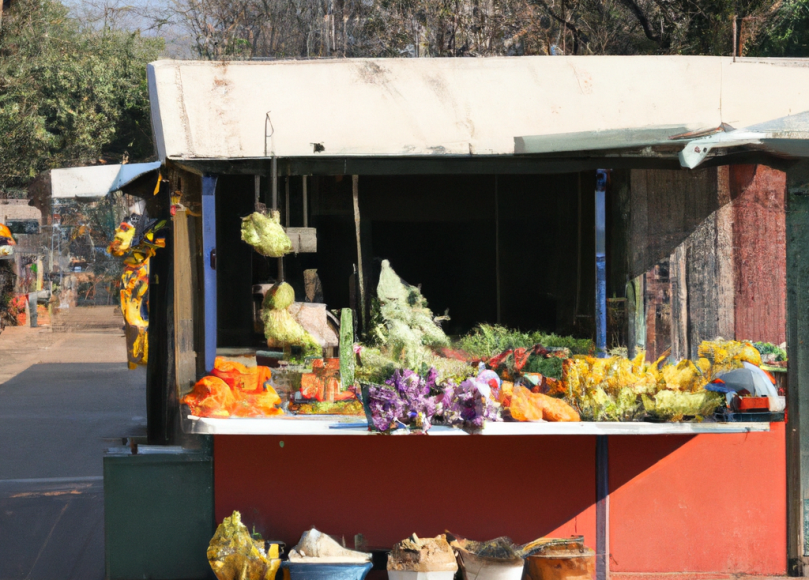
In 2023 I noted that independent stores were no longer just a place to grab bread and airtime. That has become more true. Consumers now buy larger baskets at the corner shop, and for many households it is where most of the month’s shopping happens. Spaza owners respond quickly to what their customers want, stocking what sells and dropping what does not, and that agility remains one of the channel’s biggest strengths.
[FIELD NOTE: Anything you have seen in townships or independent stores recently, for example how spaza owners buy their stock.]
What it means for manufacturers
The shift matters for brands. A product that is losing volume in the chains but growing in traditional trade needs to be on the shelf in both. Shoppers are quick to switch when a product is out of stock, and if a key line goes missing in a supermarket, they may simply buy a competitor’s brand instead.
Traditional trade is also a harder place to win. A spaza has a few metres of shelf space, not a whole aisle. As NIQ’s Ali Haeri put it, in traditional trade “it is a winner-takes-all dynamic”: the shop stocks the one or two brands it knows will sell, and everyone else is left off. For manufacturers, that means getting distribution, availability and pricing right through the wholesalers and distributors that serve the channel, because the shopper will not go looking for you.
First published in August 2023. Updated November 2026.

