
 Posted by
When I arrived in Ethiopia in 1998, the local Coca-Cola operation was hardly the place to look for best practice. Trucks could not reach most of the small shops, kiosks and bars where Ethiopians actually bought their drinks, and those outlets were served irregularly, if at all.
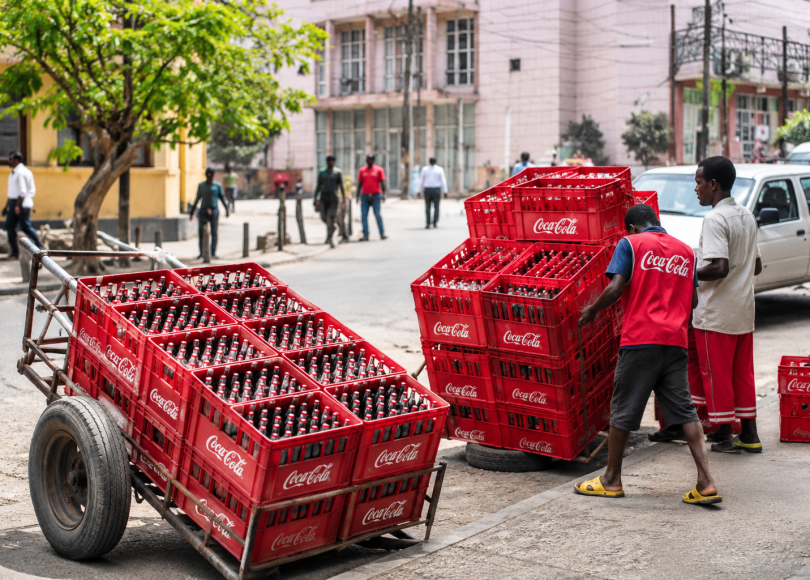
The answer we developed was the manual distribution centre, or MDC. I designed the model, and we launched it in 1999. The idea was simple: instead of sending large trucks into crowded neighbourhoods, the bottler delivers in bulk to a small, independently owned depot, and the owner’s team takes the product to nearby outlets by pushcart, bicycle or on foot. Each MDC serves a defined area, knows its customers personally and can deliver small quantities often.
One of the hardest problems in those early days was finding the right entrepreneur. The model only worked if the owner was hands-on, running the depot day to day and knowing the outlets personally, and was willing to stay within their own area rather than chase customers in a neighbour’s territory. Someone looking for a passive investment, or for quick volume wherever they could find it, would undermine both the service to outlets and the network as a whole. Getting that selection right mattered more than almost anything else.
Ten years later, Harvard University and the IFC studied the model and published a report on the Coca-Cola MDC model (PDF). By then it was seen both as a highly effective way to distribute and as an inclusive business that created opportunities in the community. It had been rolled out in a number of African countries, and the report estimated it was generating around 12,000 jobs and more than $500 million in annual revenue. In Ethiopia, the report found that:
- 75% of MDC owners were first-time business owners
- 80% of owners relied on the MDC as their only source of income
- 80% of staff and 95% of owners said they were earning more than before
- each MDC employed 3.9 people on average
- 19% of owners and 8% of staff were women
- 80% of owners and 90% of pushcart operators had received training
Much of the credit goes to the Ethiopian team who made it work on the ground.
Since then
The MDC idea has spread and evolved. Coca-Cola’s bottlers across Africa now rely on networks of small independent distributors to reach outlets that big trucks cannot serve, but with far more support and data than we had in 1999. In Uganda, for example, a network of Official Coca-Cola Distributors is tracked daily, with the bottler stepping in to help those that are struggling and supplying tens of thousands of coolers to the shops they serve.
Ethiopia itself has become one of the largest and fastest-growing markets for Coca-Cola Beverages Africa, the bottler that runs it, with five plants in the country, and the company still describes its distribution as working with thousands of small businesses. Ownership is also changing: Coca-Cola HBC has agreed to buy a 75% stake in Coca-Cola Beverages Africa, a deal expected to close by the end of 2026.
What began as a fix for one market’s delivery problem has become standard practice across emerging markets: small, local distributors who know their customers, delivering little and often to the outlets that matter most.
First published in 2009. Updated November 2026.


Good.