

 Posted by
A decade of health technology has shown that many of Africa’s medicine supply problems can be solved at the last mile. Drones have cut blood delivery times and waste, and digital stock systems have reduced stockouts. Who pays for it all is another matter. Ventures that relied on venture capital or donor money stalled when that money stopped, and the US aid cuts of 2025 showed how much of the continent’s medicine supply still runs on someone else’s budget.
Two in three Africans say they or a family member went without medicine or treatment in the past year, and 71% of those who used a public clinic cite a lack of medicines or supplies. In most cases the medicine exists somewhere in the system. It just doesn’t reach the shelf in the right quantity, at the right time and in genuine form.
Why medicines don’t arrive
Africa carries about a quarter of the world’s disease burden, and its population is projected to reach around 2.4 billion by 2050. But the bottleneck is less often the medicine itself than the chain that carries it. Four problems recur.
The first is fragmentation. A medicine typically passes from manufacturer or importer through central medical stores, regional depots, private wholesalers and distributors before reaching a clinic, pharmacy or drug shop. Each handover adds cost and delay, and each is a point where stock can be lost, expire or be stolen.
The second is stockouts. Facilities often order late, on paper, with little visibility of what they actually use. In South Africa, which has the world’s largest HIV treatment programme, a 2015 national survey found 36% of public facilities had a stockout of at least one HIV or TB medicine in a three-month period. In a quarter of cases, patients left without medicine or with an incomplete regimen.
The third is dependence on donors. For HIV, malaria, family planning and maternal health, procurement and distribution in many countries have long been run or funded by external donors. That kept products flowing, but national systems never fully owned or financed their own supply chains.
The fourth is falsified and substandard products. Where genuine stock is missing, fake or poor-quality products fill the gap, and long chains with many middlemen make that easier.
I have seen all four problems most clearly on my many visits to Nigeria, where a large share of the country’s medicines has long moved through sprawling open drug markets such as Idumota in Lagos, Bridgehead in Onitsha and Ariaria in Aba. These markets supply pharmacies, patent medicine vendors and informal sellers across the country, yet trading happens with little oversight of where products come from or how they are stored. In February 2025, Nigeria’s regulator NAFDAC raided all three, closing more than 11,000 shops and removing 138 truckloads of suspected counterfeit and expired medicines. The government’s plan is to move this trade into regulated Coordinated Wholesale Centres, a goal first set for 2018 and still unfinished.
What technology promised
Over the past decade, start-ups, governments and donors have tried technology at almost every link in the chain. Mobile and cloud systems show stock levels at each facility so stores can resupply before shelves run empty, and route tracking shows where stock is in transit. Drones fly blood, vaccines and emergency medicines to remote clinics in minutes rather than hours.
Pharmacy supply businesses digitise ordering, stock management and credit for private pharmacies and drug shops, which are the first point of care for many patients. Telemedicine links patients in remote areas to doctors, with prescriptions sent straight to a pharmacy, and mobile money lets people pay for medicines and services by phone.
Each of these has been tried at scale somewhere on the continent. Fewer have lasted.
What worked and what didn’t
The technology has mostly worked. The business models and financing behind it have been far less reliable.
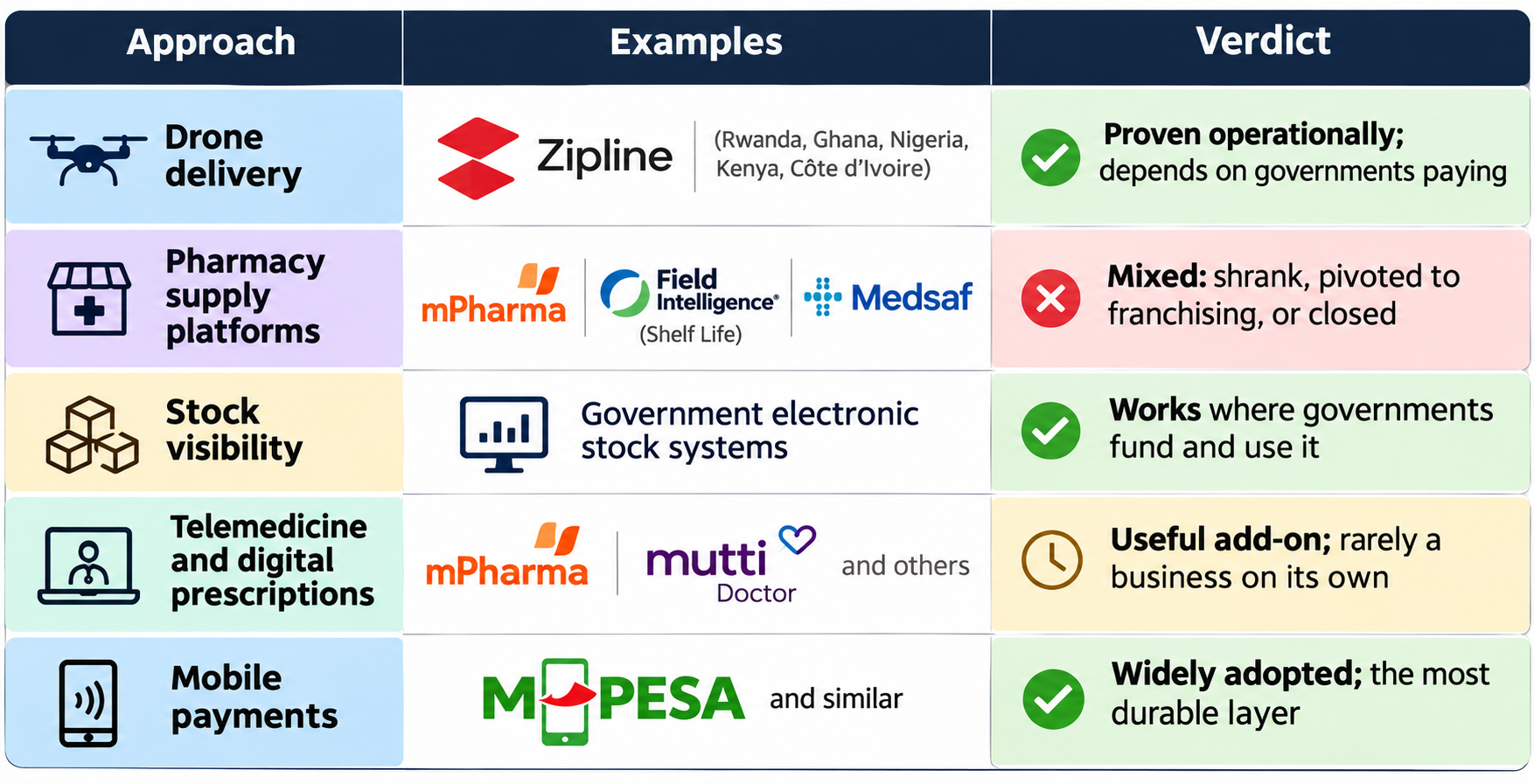
Drone delivery
Zipline is the continent’s best-known health logistics success. In Rwanda, a 2022 study found its drones cut blood delivery times by 61% and blood unit expiries by 67%. In late 2025 the US State Department committed up to $150 million in results-based funding to scale Zipline across Rwanda, Ghana, Nigeria, Kenya and Côte d’Ivoire, reaching up to 15,000 health facilities. African governments are expected to co-finance the network through multi-year service contracts.
This is also where the model is vulnerable. In Ghana, the government reportedly ran up around $15 million in unpaid bills, and Zipline suspended three distribution centres in late 2025. Without reliable payment from ministries of health, even a proven service stalls.
Pharmacy supply platforms
mPharma, founded in Ghana, raised more than $65 million and at one point operated in up to nine countries, buying pharmacy chains in Kenya, Uganda and Nigeria. After layoffs in 2023 and a long restructuring, its founder stepped down as CEO in 2025. It now focuses on four core markets, Ghana, Nigeria, Togo and Benin, and grows through a franchise model that upgrades existing independent pharmacies rather than owning them.
Others fared worse. Nigeria’s Medsaf, which raised over $7 million to digitise drug procurement for hospitals, shut down in March 2024 after currency shocks and investors pulling out. Field Intelligence’s Shelf Life, which managed stock and credit for more than 700 pharmacies in Nigeria and Kenya, showed the subscription model could work at small scale.
As in FMCG retail, working with existing pharmacies and wholesalers has proved more durable than trying to replace them.
Stock visibility, telemedicine and payments
Electronic stock management systems have improved visibility where governments fund them and staff actually use them, but they often stop at district level and depend on donor-funded technical support. Telemedicine works best attached to a pharmacy or clinic, as with mPharma’s mutti Doctor, rather than as a standalone service. Mobile money has been the most durable of all, and now underpins payments, insurance and credit across much of East and West Africa.
Côte d’Ivoire, where I have worked, is a good example. Public health facilities order their medicines from the national public health pharmacy, the Nouvelle PSP, through eSIGL, an electronic logistics system based on the open-source OpenLMIS platform. It was introduced in 2015 with USAID-funded support and later handed over to the Nouvelle PSP to manage, with outside technical support continuing to maintain it. The country has also worked on the physical side of the chain: optimising 155 last-mile delivery routes for the central medical store cut delivery lead times by 17% and distances by 25%. It shows what a national ordering system can do when the central store owns it, and how much it can still depend on outside support to keep running.
Côte d’Ivoire, where I have worked, is a good example. Public health facilities order their medicines from the national public health pharmacy, the Nouvelle PSP, through eSIGL, an electronic logistics system based on the open-source OpenLMIS platform. It was introduced in 2015 with USAID-funded support and later handed over to the Nouvelle PSP to manage, with outside technical support continuing to maintain it. The country has also worked on the physical side of the chain: optimising 155 last-mile delivery routes for the central medical store cut delivery lead times by 17% and distances by 25%. On the ground, though, the picture was messier. Many of the stores I visited still kept paper records alongside the electronic system, in effect running two systems in parallel. Part of the reason was that too many new models and tools had been introduced at once, so staff never fully moved over to any of them. The lesson is that a national ordering system only works when the central store owns it, it is simple for staff to complete, it does not try to do too much at once, and the old paper system is actually retired.
The 2025 aid shock
The US aid cuts of 2025 exposed the weakness of these supply chains more than anything before them. No technology could make up for funding that stopped almost overnight.
The US government’s main health supply programme, the Global Health Supply Chain Procurement and Supply Management project (GHSC-PSM), covered 73 countries and spent $1.15 billion in 2024 on donated medicines and technical support. About 71% of its procurement was for HIV, 20% for malaria and most of the rest for family planning. In early 2025, the dismantling of USAID froze or ended much of that work. Roughly 65% of USAID-managed PEPFAR awards were terminated or left in limbo.
The effects moved down the chain within weeks. Medicines sat in central warehouses, even where products were already in the country, because the contracts that paid for trucks, staff and data systems had stopped.
Stockouts followed. In Kenya, a study across three counties found that availability of most HIV commodities fell between 2022 and 2025, and in Isiolo County availability of magnesium sulphate for pre-eclampsia dropped from 35.7% to 15.4% . Cuts to technical assistance also removed many of the people who forecast demand, ran stock systems and solved problems at district level.
In 2026 the US began moving to bilateral agreements with individual countries in place of contractor-run programmes, shifting more responsibility, and more cost, to national governments.
For anyone designing supply chains, the lesson is hard to ignore. Many of Africa’s best-performing medicine supply chains were never national systems. They were donor systems running alongside government ones, and when the funding stopped, the national systems underneath were not ready to take over.
Malawi, one of the most aid-dependent countries on the continent, shows how deep the damage went, and it came up again and again in my discussions there. USAID had been spending more than $350 million a year in Malawi, and a large share of that was cut. USAID funded much of the country’s medicine supply chain, and the system for transporting laboratory samples was suspended. More than 4,500 HIV programme staff employed through implementing partners lost their jobs. Clinics reported stockouts of HIV and TB drugs and antibiotics, and some cut the supply of HIV medicine they gave patients from six months to three months or even one. Doctors increasingly send patients to buy medicines from private pharmacies because public facilities have run out. The government has responded by allocating more of its own budget and planning to recruit 6,000 health workers, but it is filling a gap that took decades of donor funding to create.
Falsified medicines and traceability
A medicine that arrives on time is still useless if it is fake. The WHO estimates that about one in ten medical products in low- and middle-income countries is substandard or falsified, and 42% of the reports it received came from Africa. A more recent review of 27 African studies found that more than a fifth of 7,508 samples failed at least one quality test. The UN Office on Drugs and Crime puts the toll at up to 500,000 deaths a year in sub-Saharan Africa. Antibiotics and antimalarials are the most commonly falsified, which also fuels antimicrobial resistance.
This is a supply chain problem as much as a regulatory one. Fakes enter where genuine stock runs short and where long chains of middlemen make it hard to trace where a product came from. When a country faces a shortage, the WHO has noted, falsified versions can fill the gap within days.
Shortages and falsification are closely linked, so the aid cuts, by creating shortages, also created openings for fakes.
Technology can help, but only if it covers the whole chain. Scratch codes or scannable serial numbers let a pharmacist or patient check a pack at the point of sale. Track-and-trace systems record each handover from manufacturer to shelf, so regulators can see where a product left the legitimate chain.
Just as important is shortening the chain itself, so that fewer unlicensed intermediaries handle stock in the first place.
What it means for you
For governments and ministries of health, the aid cuts turned supply chain financing into a national responsibility almost overnight. The priority is to own and fund the systems that already work, such as forecasting, warehousing, stock data and distribution, rather than to buy new technology. Drone and digital services only last if their contracts are budgeted for and paid on time.
For manufacturers and distributors, private pharmacies and drug shops matter most. They are the first point of care for millions of patients and the most exposed to fakes. Partnering with existing pharmacy networks and wholesalers, with authentication and traceability built in, protects both patients and brands.
Donors and development finance institutions should fund the systems countries will keep using: data systems, local procurement capacity and the people who run them. Every programme needs an exit plan that leaves a working national system behind rather than a parallel one.
For investors and founders, the healthtech models that have lasted are asset-light, work with existing pharmacies and earn from services, data or finance rather than from owning stock and outlets. The question to ask early is who pays when the grant or funding round runs out, and whether a government customer can pay its bills.
Who pays for the last mile
Technology has shown that a blood unit can reach a rural hospital in under an hour, and that a pharmacy can know what it will run out of next week. What remains unresolved is who pays to run these systems year after year, and whether national supply chains can stand on their own when outside money leaves.
The countries that come out of the aid shock strongest will be those that treat medicine supply as core infrastructure, funded like roads and power, rather than as a project.
First published July 2023. Rewritten November 2026.
TSCL advises governments, manufacturers, donors and investors on healthcare supply chains in emerging markets, from market entry and distribution design to tackling falsified medicines.

