

 Posted by
A supply chain is simply how a product gets from where it is made to where it is used: sourcing, production, storage, transport and sale. In Africa, those chains decide whether a farmer’s crop reaches a market before it spoils, whether a factory can compete with imports, and whether a country can sell more than raw materials to the world.
When I wrote the first version of this paper for the Wilson Center in 2018, my argument was that Africa’s supply chains were weak, fragmented and expensive, and that fixing them was one of the fastest ways to boost trade and create jobs. Eight years on, some things have moved: a continental free trade area is in force, several big rail and port projects have been built, and mobile technology has spread further. But the core problems are stubbornly familiar.
The urgency comes from Africa’s population. The continent passed 1.5 billion people in 2024 and is projected to reach about 2.5 billion by 2050, when more than one in four people on earth will be African. Five of the eight countries expected to drive more than half of global population growth to 2050 are African: Nigeria, Ethiopia, Egypt, Tanzania and the Democratic Republic of Congo. Every year, 10 to 12 million young Africans enter the job market, but the formal economy creates only around 3 million new jobs. Governments and regional bodies know that better supply chains, more trade between African countries and less dependence on raw exports are among the few ways to close that gap.
Still selling raw materials
Africa’s exports reached about $689 billion in 2025, but that is still only around 2.6% of world exports, almost exactly where the continent stood when I wrote the original paper. The bigger problem is what Africa sells. According to UNCTAD, 46 of Africa’s 54 countries still earn more than 60% of their export income from raw commodities such as oil, minerals and unprocessed crops. In Central and West Africa, the figure is closer to 80%.
That matters for supply chains because raw materials leave the continent with little value added. The processing, packaging and branding, and the jobs that come with them, happen elsewhere. When I wrote the original paper, intermediate goods (products that still need processing) made up around 60% of Africa’s imports and more than 80% of its exports, and only about 6% of African jobs were in manufacturing. The picture has barely changed. Manufacturing still contributes only about 11% of Africa’s GDP, against a global average of more than 16%, and the continent accounts for under 2% of global manufacturing and about 1.4% of manufactured exports. In several countries, manufacturing’s share of jobs has actually fallen since 2010.
Most African governments understand what weak industrialisation costs them, above all in jobs, with youth unemployment in some countries above 50%. But industrialisation depends on reliable power, roads and ports, access to bigger markets and skilled workers. Most of those are supply chain problems, and the skills gap means any push to industrialise has to come with serious investment in education and vocational training.
The gaps show up clearly when you look at where companies source their inputs. Mining companies have built some links with local suppliers, but in textiles and agriculture regional supply chains remain largely untapped: in 2018, less than 10% of inputs were sourced from within Africa. Agriculture is the most troubling case. When I wrote the original paper, it employed around 65% of Africa’s workforce and accounted for about a third of GDP, yet Africa held some 60% of the world’s uncultivated arable land and still imported close to $50 billion of food a year. Weak links between farms, processors and markets mean crops are lost after harvest and local processors struggle to get consistent supply. Fixing agricultural supply chains is central both to food security and to Africa claiming a bigger share of global trade.
Trading with each other
In 2018, African countries traded remarkably little with each other: only around 10 to 15% of their trade stayed on the continent, compared with about 60% within Europe. The big hope was a continental free trade area.
Part of the reason is fragmentation. Africa has eight regional economic communities officially recognised by the African Union and several more regional bodies with economic mandates. Many countries belong to more than one, with overlapping rules and different economic strategies. Even within a single bloc, cooperation can break down, as the long-running tariff disputes between Kenya and Tanzania in the East African Community showed. A first step towards unifying them was the Tripartite Free Trade Area, signed in 2015 by COMESA, the East African Community and SADC.
That agreement now exists. The African Continental Free Trade Area (AfCFTA) was signed in Kigali in March 2018 and trading under it began in 2021. By September 2026, 50 countries had ratified it. Trade between African countries reached an estimated $220 billion in 2025, and the AfCFTA Secretariat expects around $250 billion in 2026.
But the share of Africa’s trade that stays on the continent has barely moved, at roughly 15 to 17%. Only about half of the countries that ratified the agreement are actually trading under its preferential rules. Exporters still struggle with rules of origin, incomplete tariff schedules, slow customs and the cost of proving where a product was made.
The opportunity is real, and it is a supply chain opportunity. Trade between African countries is far richer in manufactured and processed goods than Africa’s exports to the rest of the world. But a free trade agreement on paper does not move a truck across a border. That still depends on roads, border posts, paperwork and finance.
If it is fully implemented, the prize is large. The World Bank estimates that the AfCFTA could lift 30 million people out of extreme poverty and raise the incomes of nearly 68 million more by 2035, boosting Africa’s income by about $450 billion, or 7%, and its exports by $560 billion, mostly in manufacturing. Women’s wages would rise slightly faster than men’s, and the biggest falls in poverty would come in the poorest regions, led by West Africa with 12 million people lifted out of extreme poverty. Tellingly, about $292 billion of the $450 billion would come not from cutting tariffs but from trade facilitation: less red tape, simpler customs and lower compliance costs. In other words, most of the benefit depends on fixing the supply chain.
The World Trade Organization
At a global level, the WTO’s Trade Facilitation Agreement, which came into force in 2017, set out to make trade rules more transparent, simplify customs and cut transaction costs. When I wrote the original paper, 22 African countries had not yet ratified it. Most have since done so and are now implementing it, although many depend on donor support to put the reforms in place.
The concerns African governments raised at the time have not gone away. Subsidies paid to farmers in rich countries still make it hard for African farmers to compete, and rules protecting pharmaceutical patents still raise questions about access to affordable medicines. Both shape how far African countries are willing to open up.
China, Europe and the United States
China’s lead as Africa’s largest trading partner has only grown. It took that position in 2009; trade between the two had grown from about $10 billion in 2000 to close to $90 billion by 2010. In 2025 it reached a record $348 billion, up almost 18% in a year. But the relationship is lopsided: Chinese exports to Africa surged as US tariffs pushed Chinese manufacturers to find new markets, and Africa’s trade deficit with China jumped to about $102 billion. Africa still mostly sells China what comes out of the ground and buys back what comes out of factories.
China has also been Africa’s most visible infrastructure builder and lender. When I wrote the original paper, Chinese firms or finance were involved in more than 40% of infrastructure projects on the continent, much of it funded through the Export-Import Bank of China. Chinese lending has since fallen well below its mid-2010s peak, and Beijing now leans more on trade, including zero-tariff access for most African countries.
The United States has gone the other way. Trade with Africa peaked at almost $100 billion in 2010, then fell sharply as US oil imports dropped, even though the US remained a leading source of new investment projects. The cornerstone of the relationship has been the African Growth and Opportunity Act (AGOA), which gives eligible countries duty-free access for more than 1,800 products on top of the general preference scheme. But most US imports from Africa have always been oil, with clothing, vehicles and some agricultural products making up much of the rest.
In 2018 I argued that trade deals such as AGOA were too short to support long-term investment in industries such as textiles and manufacturing. That problem has got worse. AGOA lapsed in September 2025, was revived in February 2026 for less than a year, and expires again at the end of 2026. Meanwhile, US tariffs introduced in 2025 have cut into many of AGOA’s benefits, with South Africa hit hardest at 30%. For a clothing factory in Kenya or Lesotho, planning more than a year ahead has become almost impossible.
Europe remains a major partner, and the lesson from all three relationships is the same: African exporters need markets they can rely on, and the most dependable of those may increasingly be each other.
Roads, ports, rail and air
The physical side of Africa’s supply chains is where progress is most visible, and most uneven.
The big picture
The World Bank’s Logistics Performance Index judges a country’s logistics on things like the quality of its infrastructure, the efficiency of customs, the competence of local logistics providers and the ability to track goods from source to customer. In the most recent edition, from 2023, South Africa rose to 19th in the world, its best-ever position, but it remains the only African country in the top 20. Most others are still clustered towards the bottom, and in 2018 twelve of the bottom 20 countries were African.
Two features of African markets make logistics especially hard. Third-party logistics providers are still thin on the ground, so many companies run their own trucks and warehouses. And retail is dominated by small informal shops, which make up around 70% of the market, so goods have to reach millions of tiny outlets rather than a few big stores. On top of that, 15 of Africa’s 55 countries are landlocked, which means the state of a neighbour’s port and roads can matter as much as their own.
Roads
Roads remain the backbone of trade within Africa, and the biggest single obstacle. When I wrote the original paper, only around 43% of Africans had access to an all-season road. Quality varies hugely: about two-thirds of roads in North Africa’s Maghreb were paved, compared with less than 10% in Central Africa. Moving a container inland is slow and costly. From Mombasa to Kampala is more than 1,100 km and about eight days; from Dakar to Bamako, about seven.
Ports
Ports handle more than 90% of Africa’s trade, yet the continent still accounts for only about 4% of global container traffic. Delays remain a serious problem. In Nigeria, containers still wait 10 to 18 days on average, compared with 7 to 10 days in Lomé and Tema and three to five days at the world’s best ports. The causes are familiar: multiple agency inspections, duplicated paperwork and partial automation.
There has been progress. Durban, long one of the world’s slowest container ports, recorded the biggest one-year improvement of any port worldwide in 2025, although Cape Town and Durban still ranked among the lowest of 400 ports in the World Bank’s port performance index. Mombasa, which I held up as a model in 2018, has struggled with congestion since late 2025. Global operators such as MSC, DP World and AD Ports are investing heavily in African terminals, which should raise standards over time.
Railways
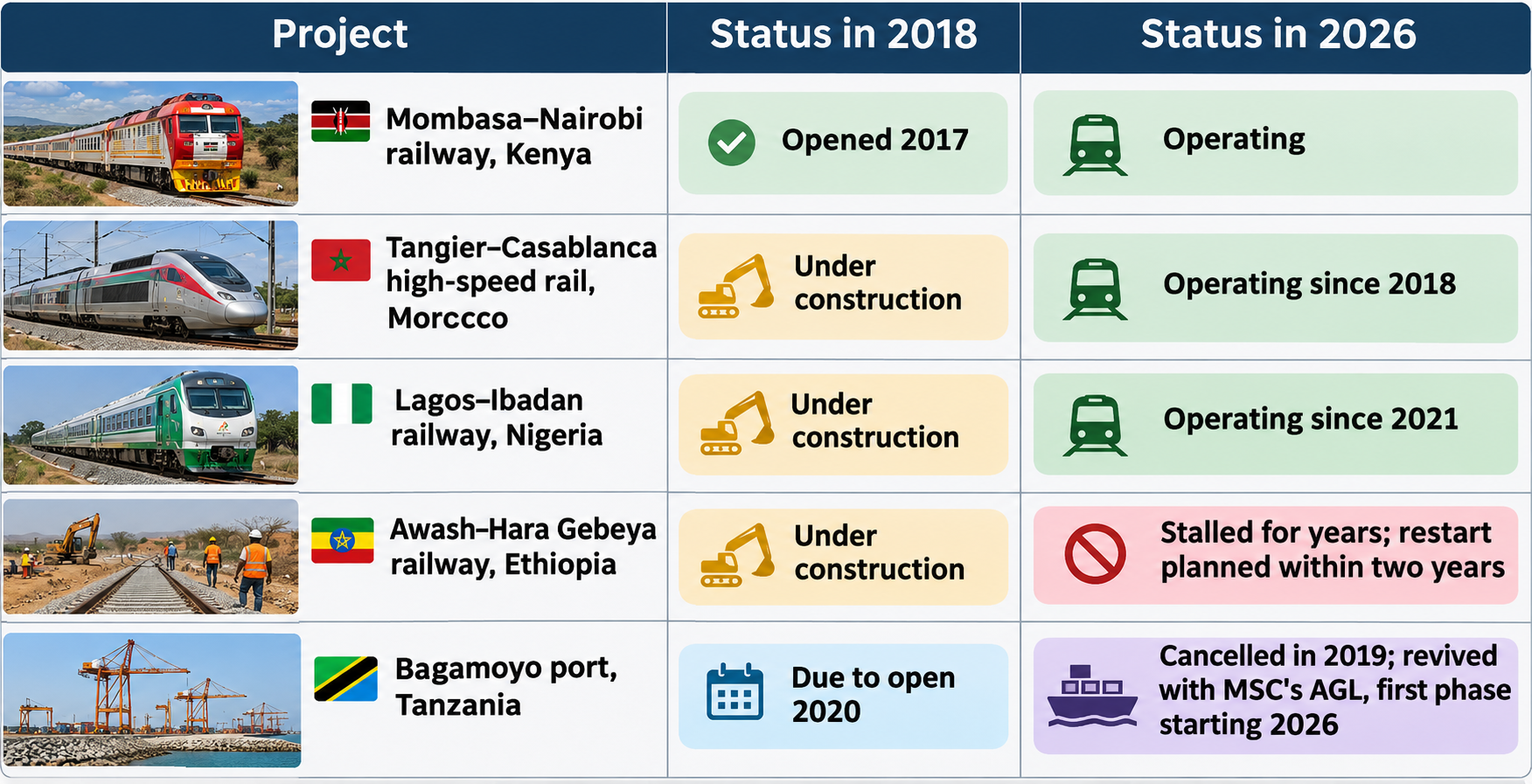
Africa’s railways are in even worse shape than its roads. Many are colonial-era narrow-gauge lines, often of different sizes from one country to the next, which makes it hard to link networks across borders. New standard-gauge lines have changed the picture in some places. Some of the big projects I listed in 2018 have since been built, while others have stalled.
Air
Africa has less than 1% of the global air freight market, yet long distances and poor roads make air transport more important here than almost anywhere. The obstacle is closed skies. African governments agreed to open their aviation markets in the Yamoussoukro Decision of 2000, but most never implemented it. The Single African Air Transport Market, launched in January 2018 to finish the job, now has 38 to 39 member countries, but airlines say few have actually opened their routes. It is often still easier to route cargo between two African countries via the Middle East.
Paying for it
African governments have invested heavily in transport corridors such as the Abidjan–Lagos corridor along the West African coast and the Northern and Central Corridors linking East and Central Africa, and new corridors such as Lobito, linking Angola, Zambia and the DRC, are under way. But the gap remains enormous. In 2016 African countries invested around $26 billion in infrastructure, against the $95 billion a year the World Bank then estimated was needed; the African Development Bank now puts the need at $130 to $170 billion a year.
Borders, power and technology
Crossing an African border is still one of the slowest and most expensive parts of moving goods. Paper-based clearance, duplicated checks by different agencies and informal payments add days and cost to every shipment. Some countries have made real progress with electronic single windows and joint border posts, but they remain the exception.
Power is the other constraint. Hundreds of millions of Africans still have no electricity, and many businesses that are connected rely on diesel generators when the grid fails. Without reliable power, cold chains for food and medicine, factories and warehouses all cost far more to run.
Technology is where the most change has happened since 2018. Mobile money has spread across much of the continent, new undersea cables have raised broadband speeds, and a growing number of companies use phones to take orders from small shops, track deliveries and give credit based on real sales data. The Pan-African Payment and Settlement System now lets traders pay each other in local currencies rather than dollars. But even here the gap is wide, and uneven between countries: only around 28% of Africans were using mobile internet in 2025, mainly because phones and data are still too expensive for many.
The real prize is visibility. When suppliers, distributors and retailers can share information along the chain, they can see where stock is, where it gets stuck and which links are weakest. That builds trust between partners, helps them decide where to fix the chain first, and creates the data needed for better decisions in future.
What would make the biggest difference
The recommendations I made in 2018 still hold. If anything, the past eight years have shown which ones matter most.
Make the free trade area work at the border. Ratification is done; what matters now is whether a trader can actually use it. That means simple rules of origin, complete tariff schedules, digital customs and border posts where agencies work together rather than in sequence.
Build, finish and maintain infrastructure. Too many corridors, railways and ports have been announced, started and abandoned. Fewer projects, properly financed through public–private partnerships and blended finance, and finished, would do more than many that stall halfway.
Add value before goods leave. Regional processing and manufacturing hubs, especially in agriculture, would keep more of the value and the jobs on the continent, and give the free trade area something to trade.
Tackle market fragmentation. Regional economic communities and governments should commit to clear industrial strategies and build regional manufacturing clusters, so that producers can reach the scale that national markets alone cannot offer.
Put money into neglected sectors. Agriculture employs more Africans than any other sector, yet its supply chains get far too little investment. Directing finance and incentives towards farming, processing and the logistics behind them would improve food security and create jobs at scale.
Give exporters time to plan. Short-term trade deals discourage the investment that industries such as textiles and food processing need. Africa’s partners should offer longer, more predictable terms, and African governments should be wary of building industries on preferences that can vanish in a year.
Back the people and tools that move goods. Training for logistics staff and small businesses, finance for traders, and support for start-ups that bring data, payments and visibility to supply chains all help the chain work better at its weakest links.
Make it easier to invest in logistics technology. Governments can create an investor-friendly environment for new logistics technology and offer incentives for start-ups and for technology investment in rural areas. The private sector and venture investors can help by backing incubators that help these businesses scale.
Help businesses meet global standards. Training on certification and accreditation, and on what it takes to access overseas markets, would help African companies move up their value chains, both within the free trade area and beyond.
Address Africa’s concerns at the WTO. Farm subsidies in rich countries and rules on medicine patents remain real barriers. Resolving them would make African governments more willing to open up.
The paper was first published in March 2018 by the Wilson Center.

