
 Posted by
In October 1990, when Rwandan Patriotic Front troops poured over the border from Uganda, Zaire’s President Mobutu Sese Seko scoffed that Rwanda’s President Habyarimana should never have built a road to his house. Mobutu took his own advice. Decades later the Democratic Republic of the Congo still has only a few thousand kilometres of paved road, in a country the size of Western Europe. Algeria, of similar size, has well over 70,000 km.
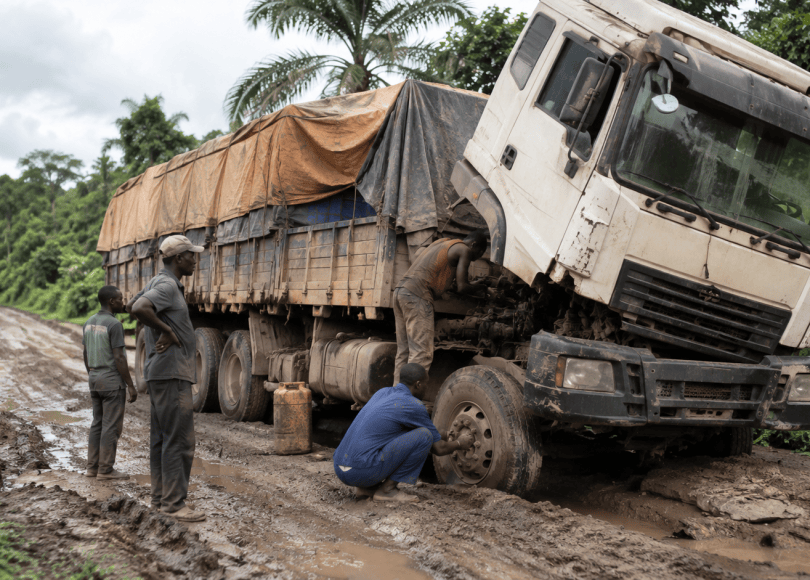
Many of the main connecting roads are dirt tracks that turn to mud in the rainy season. Trucks break down, and arrival times are measured in days rather than hours. Congolese drivers are in demand across the region for that reason. As one logistician in Juba put it to me diplomatically, “they are respected for their ability to negotiate difficult terrain and operate in an environment where spare parts aren’t always readily available.”
A vast country that geography works against
The DRC is 80 times the size of Belgium, its former colonial power, and about a quarter of the size of the United States. The former Katanga region alone is the size of Spain. Yet the country is all but landlocked, with only a short strip of Atlantic coast, and borders nine neighbours. Tropical forest and some 15,000 km of waterways make road building hard and expensive. Import and export costs have long been estimated at 40 to 50% higher than in other, coastal Sub-Saharan countries.
The DRC has also spent years near the bottom of most business and development rankings. In 2014 it ranked 184th of 189 in the World Bank’s Doing Business index, which has since been scrapped, and 157th in the Logistics Performance Index. Only around a fifth of the population has access to electricity, and many businesses still run their own generators.
The potential
On the other side of the ledger, the DRC ticks a lot of boxes. It is the world’s largest producer of cobalt and has overtaken Peru to become the second-largest copper producer after Chile. It has more navigable rivers than any other African country, and the World Bank has estimated its hydropower potential at around 100,000 MW, more than all of Sub-Saharan Africa currently generates. Inland waterways are about a third cheaper than road transport and need relatively modest investment to improve. With some 80 million hectares of arable land, the country could also be one of the continent’s breadbaskets.
Three regions, three sets of trade routes
To understand how goods move in the DRC, it helps to think of three separate economies around its main commercial centres: Kinshasa in the west, Lubumbashi in the south-east and the cities of the east such as Goma, Bukavu and Kisangani. Infrastructure linking them is poor, and each is more closely tied to its neighbours and their trade corridors than to the rest of the country.
In the copper capital of Lubumbashi, long-haul drivers know the road south through Zambia to Durban far better than any route to Kinshasa. Even though Dar es Salaam is closer, logistics companies serving the mines have long preferred the more reliable port of Durban. The south also has a rail link to Southern Africa, and the national railway, SNCC, has been used to move copper towards the south.
The east trades with Swahili-speaking East Africa and depends on the Northern and Central corridors for goods and access to markets. Since 2022 the DRC has been a member of the East African Community.
What has changed since 2016
The biggest change is in the copper belt’s routes to the sea. The Lobito Corridor, which links the mines of the DRC and Zambia to Angola’s Atlantic port of Lobito, has gone from a plan to a working railway backed by the US, the EU, the African Development Bank and the Africa Finance Corporation. The rail line from Lobito to the DRC border is operating, and recent shipments from Kolwezi to Lobito have taken as little as six days, against transit times of up to 45 days on congested routes. In July 2026 the DRC approved a US$1.26 billion deal with Mota-Engil to rehabilitate more than 1,000 km of its own railway between Dilolo and Sakania, and a new line into Zambia is planned for 2029.
China is answering with a US$1.4 billion overhaul of the TAZARA railway from Zambia to Dar es Salaam. The copper belt now has rival routes to the Atlantic and the Indian Ocean, and the choice of corridor has become as much about geopolitics as cost.
On the Atlantic coast, DP World is building the DRC’s first deep-water port at Banana, at the mouth of the Congo River, with the first phase due in early 2027. Matadi, the main port today, is too shallow for large ocean vessels, so much of the country’s cargo has to be transhipped through neighbouring ports.
Mineral policy has changed too. Kinshasa banned cobalt exports in February 2025 and replaced the ban with quotas in October, which run until the end of 2027. In 2026 it also banned exports of copper and cobalt concentrates to push more processing into the country. For logistics, this means more refined product and less raw ore on the road and rail, and companies like Glencore are now prioritising copper over cobalt.
The east: conflict and corridors
Eastern Congo has long been a refuge for armed groups, and its minerals have helped fund them. In early 2025 the Rwanda-backed M23 rebels seized Goma and Bukavu, the two largest cities in the east. Since then the US brokered a peace deal between the DRC and Rwanda, and Qatar has mediated a series of agreements between Kinshasa and M23, but fighting has continued and the rebels still hold much of North and South Kivu.
For anyone moving goods in the east, that means trade routes, border crossings and tax collection may be controlled by different authorities from one month to the next. Supply chain due diligence on conflict minerals, which began with the US Dodd-Frank Act and now includes EU rules, has become more important rather than less.
On my more recent trips, the two things that still define moving goods in the DRC are the ones I wrote about a decade ago: corruption and bad roads. New railways and ports grab the headlines, but most goods still travel by truck on roads that fall apart in the rains, and every checkpoint is an opportunity for someone to ask for money.
Politics and the road
When I first wrote this in 2016, President Joseph Kabila was heading towards a delayed election, and I noted that his late father had needed very little infrastructure to overthrow Mobutu. Félix Tshisekedi has been president since 2019. Kabila left office, went into exile, and in 2025 a military court sentenced him to death in absentia over alleged links to M23.
The lesson Mobutu drew in 1990 still holds in a different form. The DRC’s roads, railways and ports decide not only how goods move, but which neighbours and which foreign powers the country is tied to. Today the big decisions about Congo’s supply chains are being made in Washington, Beijing, Brussels and Kigali as much as in Kinshasa.
First published in 2016. Updated November 2026.

