
 Posted by
A route-to-market (RTM) plan sets out how you will get your products to every outlet you want to serve, profitably and reliably. This guide takes you through building one for emerging markets in eight steps, from analysing the market to scaling a proven model.
What a route-to-market plan covers
A route-to-market plan, sometimes called a go-to-market plan, is the strategy an organisation uses to deliver its products to its outlet base and serve its customers. It draws on internal resources, such as the sales force, and external ones, such as distributors and wholesalers.
A complete plan answers six questions:
- Channels: which channels and outlets will you serve?
- Customers: how will you segment them, and what does each segment need?
- Partners: which distributors, wholesalers or logistics providers will you work with?
- Sales: how will orders be generated, outlets developed and cash collected?
- Logistics: how will products be stored, moved and delivered?
- Economics: what will it cost to serve each channel, and is it profitable?
The goal is to make your products easy for customers to buy, through the most efficient and cost-effective channels, while protecting your margins.
Why emerging markets need a different approach
Most everyday goods in emerging markets are still sold through small, independent outlets: kiosks, corner shops, market traders and hawkers. Many are unregistered, buy small quantities often and pay in cash. Roads, power and internet can be unreliable, and regulations vary widely between countries.
Four phase approach
A plan built for modern retail will not work here. You need to understand both internal factors (your products, people, budget and systems) and external ones (infrastructure, regulation, competitors and partners) before you design anything.
The Supply Chain Lab divides the design and roll-out of a route-to-market plan into four phases. Each phase comprises several building blocks, supported by analysis tools and key enablers.

Analysis
Start by building a clear picture of the market before you design anything. Work through the nine areas below; for each, the tool that helps most is named. The Supply Chain Lab uses several tools during the analysis phase, and we will discuss a few below. For the complete tool list (18 tools) and route-to-market framework, see our Route-to-Market Presentation, including the purpose of each tool, when to use it, how to use it, and material requirements.
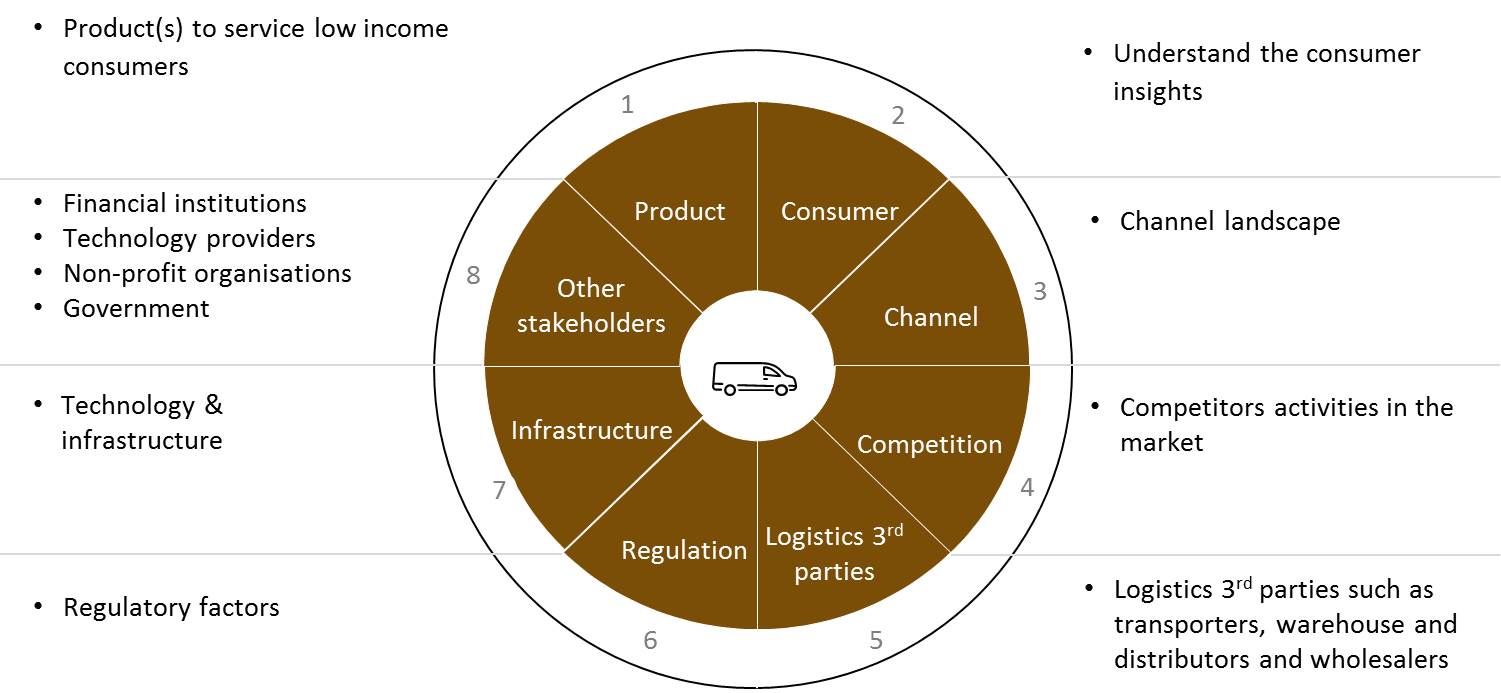
Route-to-market analysis steps
1.1 Check that your product fits the market
Make sure your product meets the target consumer’s needs at a price they see as value. In most emerging markets cash is still king, so price to what people have in their pockets: small packs and affordable price points often matter more than features. Take local culture and social norms into account too.
Tool – ranking values (value driver tree): break customer value down into its drivers, such as price, pack size, taste and availability, and rank them. This shows which drivers matter most and where the product can be improved.
1.2. Understand the consumer
Find out who your consumers are, where they live, how and when they buy and use the product, and what they think of your brand. Knowing usage occasions helps you reach the right people at the right time.
Tool – consumer insights research: use focus groups, surveys, interviews and online data to understand the attitudes, beliefs and behaviours behind buying decisions. Cover demographics, purchase behaviour, brand loyalty, usage occasions and product feedback. Brand teams use these insights to shape the product message, spot new segments and judge how current campaigns are doing.
1.3 Map and segment the channels
List every channel through which your category reaches consumers: informal traders, small groceries, wholesalers, online marketplaces, direct-to-consumer and direct selling. Each has its own advantages and costs, so decide which ones matter for your product and target market.
Tool – channel segmentation: divide channels into groups with common features, such as products, customers and outlet space. This shows each segment’s product mix, service needs, merchandising opportunities and value drivers.
Tool – customer satisfaction survey: ask customers how satisfied they are with your service and your competitors’ (also called a voice of the customer survey). Cover product quality, service and overall satisfaction, and use the results to decide what to improve.
Study your competitors
- Define the market and list the key players, both direct competitors and indirect ones with similar products.
- Compare their products and services: features, benefits, pricing and unique selling points.
- Study how they deliver: supply chain, distribution channels and customer service.
- Track their market activity: campaigns, sales performance and changes in positioning.
- Work out why they succeed or fail in the informal market, and what that means for you.
Tool – benchmarking: compare your performance with competitors’ using a set of KPIs, such as market share, service levels, customer satisfaction or operational efficiency. Compare processes too, such as distribution models and customer service. Look beyond your industry at best-in-class companies for ideas you can adapt.
1.5 Assess the logistics and distribution landscape
Review the transport network, available warehouses and distribution centres, and the third-party logistics providers (3PLs) in the market. In informal markets, many 3PLs also act as wholesalers and can reach areas you cannot. When you assess them, look at their reputation, experience, product knowledge, warehousing, transport, systems and pricing.
Tool – pricing map: map the costs and prices at each step of the chain, from your selling price through each intermediary’s margin to the shelf price. This shows the mark-ups along the chain, helps you set the right price point and gives you the numbers for a business case for each route-to-market option.
Tool – product flow: trace how products move from the manufacturer through distributors and wholesalers to outlets and consumers, including returns and rejected stock. Find out where outlets buy each category and whether they use several sources. This shows bottlenecks, inefficiencies and opportunities to consolidate orders or negotiate better terms.
1.6 Understand the regulations
Find out which laws and regulations affect your route to market: licensing, distribution rules, pricing controls, labelling and marketing restrictions, and truck access to city centres. Regulations can shape which channels you can use and how you price and promote. Non-compliance can lead to fines, legal action and reputational damage.
1.7 Assess the technology environment
Check internet coverage and reliability, the cost of importing equipment, smartphone use and digital literacy among your teams, partners and retailers. Where connectivity is poor, choose low-bandwidth, mobile-first and offline-capable tools. Where digital skills are low, budget for training. Look for local suppliers who can provide affordable equipment and support.
1.8 Assess the infrastructure
Review the condition of roads, ports, railways, airports, telecoms and electricity. Poor roads raise transport costs, slow deliveries and damage products. Weak ports delay imports. Unreliable power and telecoms disrupt operations, communication and cold-chain products. Build these costs into your model from the start.
1.9 Identify external stakeholders
List the governments, NGOs and businesses you could work with. Government can help with regulation and local networks; NGOs bring insight into communities and social impact; non-competing businesses can share supply chains, marketing channels and costs. Collaboration can also support community programmes such as training for small retailers and support for local entrepreneurs.
Design and enablers
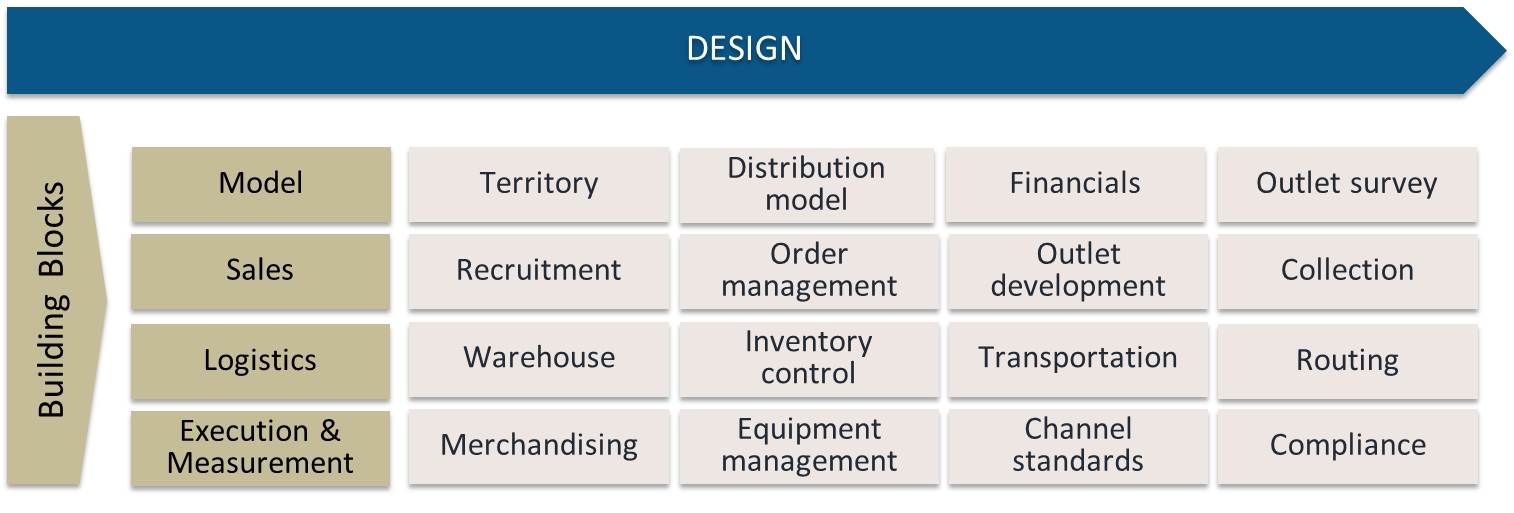
Once you have completed your analysis, you need to start the design process. Our design phase is segmented into four major building blocks that include the model, sales, logistics, and execution & measurement.
Step 2: Choose your distribution model
With the analysis done, start the design phase. It has four building blocks: the model, sales, logistics, and execution and measurement. Begin with the model: territory, distribution model, financials and an outlet survey.
2.1 Define the territory
Decide the geographic area you will serve. Its size depends on two things:
- How many potential outlets it holds: use market research to estimate outlet numbers, channel types, volumes and locations.
- How easy they are to reach: rural outlets cost more to serve than urban ones, so check which channels are available and what each costs.
Get the territory right and you can match sales, delivery and marketing resources to the real opportunity.
2.2 Decide who distributes
Choose between building your own distribution network and using third parties such as distributors and wholesalers. Most companies end up with a mix. Decide also how much control you need over functions such as outlet recruitment and development.
| Option | Advantages | Drawbacks |
|---|---|---|
| Own distribution | Full control of service, pricing and the customer experience; sales effort aligned with brand goals | High investment in warehouses, vehicles, people and systems; slower to set up |
| Distributors and wholesalers | Existing networks, relationships and local knowledge; faster and less capital to start | Less control over pricing, promotions and customer contact |
If you use third parties:
- Consider giving distributors exclusive rights to a territory or channel. Exclusivity motivates them to focus on your products and reduces channel conflict.
- Set clear performance metrics, communicate regularly and build strong relationships, so your brand is represented the way you want.
2.3 Run the numbers
For each option, work out:
- Investment: the upfront cost of your own network (warehouses, vehicles, technology), or the fees and commissions third parties charge.
- Trade margins: the margin each intermediary takes, and whether it fits your financial assumptions.
- Profitability: expected volume, pricing and operating costs, and the profit each model can generate.
Choose the model that meets your service goals at a cost you can sustain.
2.4 Survey the outlets
In emerging markets, retail is fragmented and many outlets are unregistered, so reliable outlet data rarely exists. Run an outlet survey to map:
- the number and types of outlets, from kiosks to larger stores
- their locations, to find high-potential areas and plan efficient routes
- their sizes, to set the right range, pack sizes and prices
- competitors’ presence, to judge your market share and spot gaps
- how many outlets are registered, to understand the regulatory picture
The survey becomes the foundation for territory design, routing and outlet recruitment.
Step 3: Design your sales processes
Next, design how outlets are recruited, how orders are taken, how outlets are developed and how cash is collected.
3.1 Recruit new outlets
- Set your recruitment goals and criteria: target areas, channels and the minimum requirements for a new outlet.
- Check whether your sales team has the capacity to recruit, or whether you need a dedicated team.
- If the sales team will recruit, define the extra tasks clearly: prospecting, first assessments and handing over to other teams.
- If you need a dedicated team, create an outlet activator role with clear responsibilities, skills (negotiation, research, relationship building) and reporting lines.
- Standardise the process: survey every outlet in the area, use the same assessment criteria for each, and set a clear workflow for signing up and activating new outlets.
3.2 Manage orders
Design how orders are captured, checked, recorded and tracked, whether manual or electronic.
- Capture: record the customer, contact details, delivery address, products, quantities and any special instructions. Orders may come through a salesperson, by phone, or through an app, WhatsApp or e-commerce platform.
- Verify: check stock availability, prices and discounts before confirming.
- Document: keep records of orders, invoices and related documents.
- Track: keep customers informed through confirmations and delivery updates, and flag delays early so you can fix them.
- Integrate: connect digital ordering channels to your back-end systems so orders and stock levels update automatically, with no manual re-entry.
3.3 Develop existing outlets
Grow sales and profit in outlets you already serve:
- Introduce new products: use customer feedback, purchase data and market trends to choose which products to introduce. Support launches with demonstrations, samples and incentives.
- Win better space: in informal markets, space is limited and often managed by the traders themselves. Build relationships with traders, learn their norms, and explain how your products will bring them extra sales.
- Build the relationship: talk to customers regularly about their needs and challenges. Involve traders and the community in decisions and promotions, and treat them as partners, not just customers.
3.4 Plan cash collection
Map how and when payment is received:
- Electronic payments: mobile money, QR codes, digital wallets and cards are growing. Set up the terminals, partnerships with mobile money providers or payment gateways you need.
- Cash: still dominant in many markets. Cash may be collected separately from the order, for example later in the day once the outlet has made enough sales.
- Clear terms: tell customers when, where and how to pay, and offer several payment options to suit local practice.
Step 4: Design your logistics
Logistics covers storing, moving and delivering stock from the factory to the outlet. Design three things: warehousing and inventory, transport, and routing.
4.1 Plan warehousing and inventory
- Choose the right storage: bulk storage, pallet racking, shelving or specialised storage, depending on your products.
- Plan for local conditions: warehouse facilities may be basic, automation limited and processes manual. Build simple, reliable inventory controls that work without advanced systems.
- Get close to customers: small outlets need frequent deliveries. Smaller depots near dense or high-demand areas cut transport costs, shorten lead times and improve service.
4.2 Plan transport
- Balance cost and service: transport costs are often higher in emerging markets, so look for savings without letting service slip.
- Solve the last mile: reaching outlets, especially in rural areas, is the hardest and most expensive leg. Consider local delivery partners, smaller vehicles such as motorbikes and tuk-tuks, and technology that improves last-mile delivery.
- Right-size the fleet: idle vehicles add cost; too few cause delays. Match fleet size to the volumes you need to move.
- Work with local partners: suppliers, distributors and transporters know the market and can help you handle local conditions.
4.3 Design routes
- Set the service frequency: decide how often each outlet is visited, based on demand, location and product. Some small outlets need daily service; others weekly or fortnightly.
- Build the routes: plan routes that cut travel time and fuel, taking into account distance, traffic, delivery windows and vehicle capacity. Route-optimisation software helps, but manual planning still works.
- Give teams a clear call sequence: fix the order of visits and aim to maximise the number of productive calls per day.
- Review regularly: treat routes as living plans. Use performance data and customer feedback to keep improving them.
Step 5: Set execution standards
Decide what good execution in the outlet looks like, and how you will check it.
5.1 Merchandising
- Make the most of small spaces: informal outlets have little room, so use vertical displays, simple shelving and hanging strips to keep products visible.
- Provide the materials: most small retailers cannot afford signage or displays, so supply them yourself or with your distributors.
- Fit the local context: align displays and promotions with local preferences, festivals and customs.
- Show value: shoppers are price-conscious, so make prices clear and highlight bundles and discounts.
- Rotate stock: older stock at the front, newer stock behind.
5.2 Equipment management
- Decide which outlets need equipment such as coolers and racks.
- Place it in visible, high-traffic spots, adapted to the outlet’s limited space.
- Keep it clean and working, and check it on every visit.
- Move equipment out of outlets where it does not perform. Informal retailers can agree to placements and changes quickly, which makes this easier than in modern trade, but health and safety still need attention.
5.3 Channel standards
Set the standards your sales team must deliver in each type of outlet:
- the brands and SKUs that must always be visible, and where they should sit
- how products are displayed, stocked and merchandised
- how the team engages with customers: greeting, product knowledge, answering questions and resolving complaints
Make sure the team knows the products well enough to advise customers and earn their trust.
5.4 Compliance
Set minimum standards for the sales and distribution teams, then audit them.
| Team | Example standards |
|---|---|
| Sales | Time spent in the outlet, merchandising standards met, stock rotated |
| Distribution | Minimum stock levels held, orders processed accurately, deliveries on time, documents complete |
Run a regular audit to track compliance. For distribution partners, checking minimum stock levels is especially useful: it prevents both stockouts and overstocking.
Step 6: Build the enablers
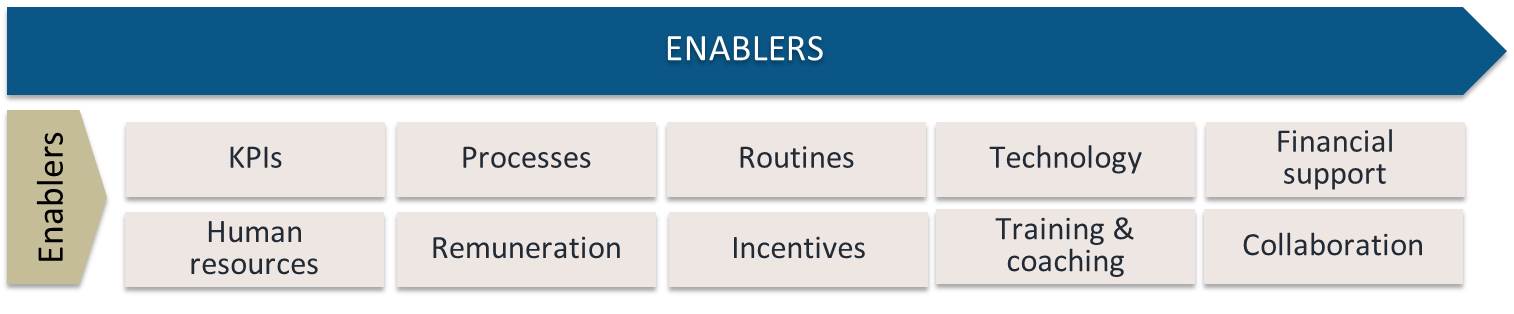
The final activity of the design phase is to develop the key enablers to support the building blocks.
Step 6: Build the enablers
The last part of the design phase is to put in place the enablers that make the building blocks work.
6.1 Set KPIs
Choose a small set of measurable KPIs that track the model’s performance and give everyone a common language. Useful ones include:
| KPI | What it shows |
|---|---|
| Outlet penetration | How much of the market you cover |
| Outlet coverage | How many outlets each salesperson visits in their territory |
| Product availability | Whether products are consistently on the shelf |
| Strike rate | The share of visited outlets that place an order |
| Order accuracy | The share of orders delivered exactly as requested |
| Delivery completion | The share of planned deliveries completed |
| Return rate | The share of products returned because of damage or defects |
| Customer retention | How many customers keep buying from you |
| Market share | Your share of category sales |
| Customer feedback | How satisfied outlets are, and what to improve |
6.2 Map your processes
Draw each step from order to delivery: order placement, stock checks, processing, picking, dispatch and delivery. Mark the decision points (when to restock, which delivery option to use) and the hand-offs between sales, warehouse and distribution. The map shows bottlenecks and duplicated work you can remove.
6.3 Set routines
Give the sales and distribution teams a standard sequence of actions, so work is consistent and easy to train. A basic sales routine covers:
- Prospecting: identify potential retailers, wholesalers and distributors.
- Order taking: take and process orders.
- Merchandising: arrange products so they catch the eye and are easy to reach.
- After-sales support: follow up on concerns and complaints.
6.4 Use technology
Mobile apps, smartphones and cloud software can automate routine work and give real-time visibility, even in the smallest outlets:
- Ordering and tracking: retailers order through an app or WhatsApp instead of by phone and paper.
- Inventory management: scan barcodes or QR codes to update stock levels instead of counting by hand.
- Route optimisation: GPS tools plot the most efficient delivery routes and save time and fuel.
- Digital payments: mobile money and QR payments reduce cash handling and the risk of fraud.
- Data analytics: dashboards give real-time insight into sales, stock and customer behaviour.
6.5 Provide financial support
Retailers and small distributors often lack financial records and a credit history, so banks see them as too risky to lend to. To help them:
- Assess the financial needs of your retailers and distribution partners.
- Use a financial model that works with limited documentation.
- Explore micro-loans and other small, manageable credit products.
- Shortlist banks and fintechs with a track record of serving small businesses.
- Partner with them to design credit products for your customers.
- Use fintech tools to simplify payments, give real-time financial insight and automate credit checks.
6.6 Recruit the right people
- Local knowledge: understanding local culture and consumers can matter as much as qualifications, so recruit locally.
- Adaptability: many candidates will not have formal corporate experience, so value the ability to learn on the job.
- Languages: speaking the local languages helps in markets with several language groups.
- Recruitment channels: use community networks and local organisations for referrals, where job boards do not reach.
6.7 Design pay and incentives
Combine a base salary, commission and other incentives. Link part of the incentive to execution and compliance standards, not just volume, and reward customer retention. Add allowances for staff working in difficult conditions. A good compensation plan aligns your team’s goals with the organisation’s and drives profitable growth.
6.8 Coach your teams
Coaching closes skill gaps, improves productivity and helps you keep good people where competition for talent is strong. Tailor it to local culture and to each person.
- Skills audit: assess each person’s current skills through self-assessment and feedback.
- Gap analysis: compare current skills with what the role needs.
- SMART goals: set goals that are specific, measurable, achievable, relevant and time-bound.
- Action plan: set out the training, workshops or self-study needed.
- Regular check-ins: meet regularly to review progress and adjust.
- Measure progress: use KPIs to track whether coaching improves performance.
6.9 Train your teams
- Assess needs: identify the knowledge and skill gaps first.
- Tailor the content: fit training to your organisation and its people.
- Cover product knowledge: features, benefits and how products compare with competitors’.
- Teach merchandising: displays, promotions and the reasons behind product placement.
- Practise handling objections: prepare answers to common objections and turn them into sales.
- Keep listening: frontline teams see market shifts first, so build in a feedback loop.
6.10 Collaborate
Work with businesses, government and non-profits to share costs, resources and networks:
Local expertise: NGOs often understand communities better than anyone, which helps when entering new areas.ommunities, which can be invaluable for businesses looking to expand or adapt in those areas.
Shared investment and risk: pool resources on joint projects and share the risk.
Shared warehousing: share space with non-competing companies, especially where demand cycles differ.
Networks: each partner brings contacts and opportunities.
Policy: work with stakeholders to shape practical regulations and standards.
Social impact: partner with NGOs on programmes for retailers and communities, which also builds your reputation.
Pilot & scale
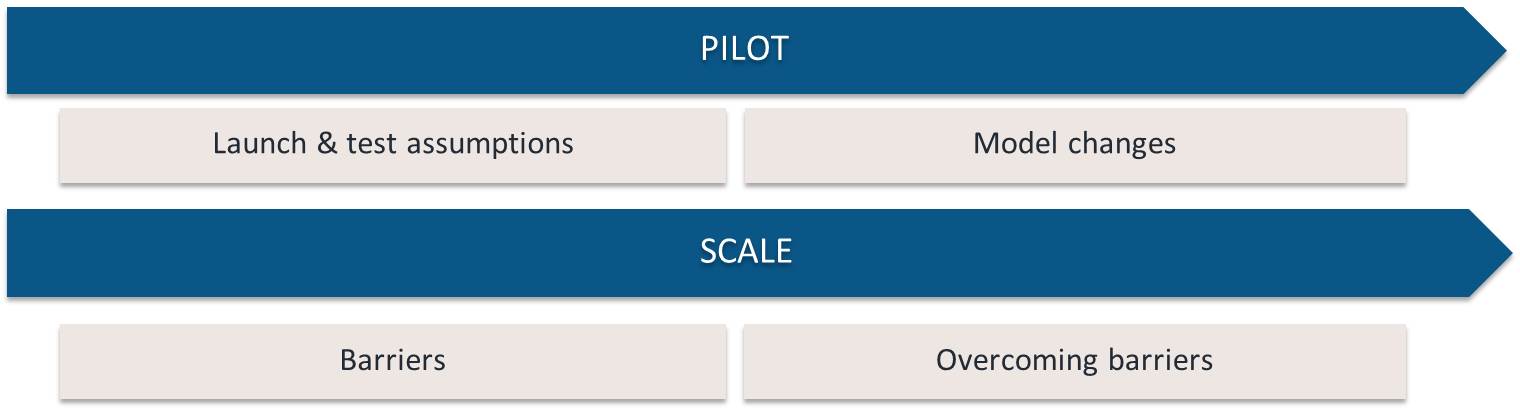
The third and fourth phase focus on piloting and scaling your route to market model.
Step 7: Run a pilot
Test the model on a small scale before committing large amounts of money. A pilot lets you find and fix problems while the risk is still low.
- Pick a test area: choose a region, city or neighbourhood that represents the wider market.
- Collect feedback: use surveys, focus groups and interviews with consumers, retailers and distributors to understand their concerns.
- Measure and refine: track sales, service levels, costs and feedback. Work out what worked, what didn’t and why, and adjust the model, product, pricing or promotions as you go.
- Document everything: record processes, insights, problems and solutions. This becomes your playbook for rolling out to new areas and markets.
Step 8: Scale the model
Once the pilot has proved the model and the changes are made, roll it out: more sales, more customers, more brands, and more jobs and entrepreneurs supported.
Expect barriers. Money and people can limit expansion; processes that work in a small area can break at scale; and what works in one market may not work in another, because consumers, preferences and competitors differ. Identify these barriers early and plan how to overcome them.
- Monitor continuously: track the KPIs and be ready to change course based on real results.
- Manage risk: scaling brings new risks, so set up a way to spot, track and reduce them.
- Keep the playbook up to date: add new processes, lessons, problems and solutions as you scale and after.
- Pause to evaluate: at set points, check that the model is still effective, efficient and aligned with your goals, and refine it.
Checklist
- Scale-up plan, risk management and playbook ready
- Product, consumer, channel and competitor analysis complete
- Logistics landscape, regulations, technology and infrastructure assessed
- External stakeholders and potential partners identified
- Territory defined and outlet survey completed
- Distribution model chosen and financials tested
- Sales processes designed: recruitment, orders, outlet development, collection
- Logistics designed: warehousing, transport, routing
- Execution standards and compliance audits set
- Enablers in place: KPIs, processes, routines, technology, finance, people, incentives, coaching, training, collaboration
- Pilot run, results measured and model refined
Framework
For a complete framework and steps to design and develop a route-market plan, see our Route-to-Market presentation (2026 edition): more than 250 PowerPoint slides covering each step of analysing, designing, piloting and scaling a route-to-market model. It includes 19 tools for analysing the market and designing processes, a section on technology in traditional trade, lessons from the B2B platforms, and 20 case studies from Africa, Asia and Latin America. It is available at

