
 Posted by
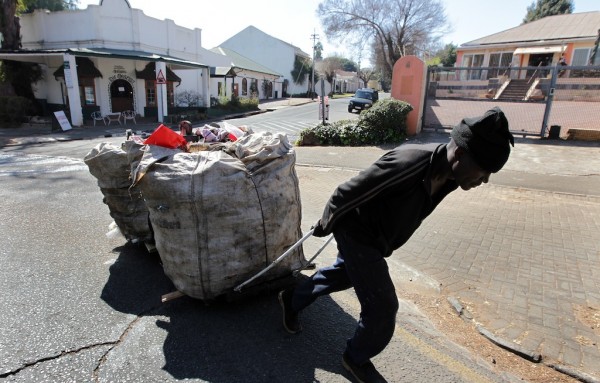
It’s Friday, and that means garbage day in Emmarentia in Johannesburg. In the competitive world of recycling, that means a 3–4 am start for most recyclers. Recycling in South Africa has a strong SADC (Southern African Development Community) flavour, with Lesotho, Zimbabwe, Botswana and Mozambique well represented. Many sleep in the city to save on transport costs and to get a head start on the competition. It is estimated that two to four recyclers go through each household bin.
Recycling is big business in South Africa, fuelled by demand for recyclable materials from local and international manufacturers. Some items, such as copper, are in high demand. In early November 2026 copper was trading at around $13,800 a tonne on the London Metal Exchange (roughly $14 a kilogram), after reaching record highs earlier in the year. I recently received a call from a Chinese friend based in Guangzhou, asking if I had any recycled copper contacts in the Democratic Republic of Congo.
Recyclers don’t always see the benefit of those prices. Under South Africa’s Price Preference System, scrapyards must offer scrap metal to local steel mills at a 30% discount before they can export it. The Recycling Association of South Africa wants the system suspended, arguing that it hits the lowest earners hardest. ArcelorMittal South Africa also opposed the policy, saying it favoured smaller scrap-fed mini-mills, and cited it as one of the reasons it closed its long-steel business in 2025.
The South African supply chain starts with an army of independent recyclers who collect recyclable goods from landfills, businesses and household bins. Informal recyclers use trolleys to move their goods and sell them to buy-back centres. From there, other intermediaries or merchants may come into play before the material is sold to local and international manufacturers. Since the introduction of Extended Producer Responsibility (EPR) regulations, producers have had to fund collection and recycling, meet targets and integrate waste pickers into the value chain. A national registration system records waste pickers, and the draft 2026 National Waste Management Strategy proposes deposit-refund schemes for packaging streams that miss their targets.
Some industries are also highly specialised and concentrated. A few years back, a trip to Bangladesh introduced me to the shipbreaking yards of Chittagong (now Chattogram), where retired ships are dismantled on the beach. In 2025, more than 85% of the world’s scrapped ship tonnage was broken up on the beaches of Bangladesh, India and Pakistan, although Bangladesh lost its top spot that year as stricter international rules came into effect.
In the recycling business, value is created through sorting, grouping and volume. Most recyclers therefore need a place to sort and store their items before selling them in bulk at better prices. Recyclers are well informed, and any recycler on the street can tell you an item’s resale value.
However, the world of the recycler is not without risk. In South Africa, recyclers are frequently harassed by Metro Police, and pushing a heavy trolley along a Johannesburg street is a dangerous business. Most earn between R300 and R600 a week. In Chattogram, an international convention on safe ship recycling came into force in June 2025, but accidents have continued, and in August 2026 nine workers were killed at a yard certified as compliant. Across the industry, the lack of protective clothing leads to injuries and exposure to noxious fumes and asbestos.
Recycling also creates jobs. Lots of them. More than 20 million people worldwide earn an income from collecting, sorting and selling recyclables, and the actual number is likely higher.
In South Africa, official unemployment stood at 33.7% in the third quarter of 2026. Several companies and organisations have developed inclusive business models around recycling (e.g. Mondi). Under EPR, producers also have to work with waste pickers, and the packaging producer responsibility organisations have partnered with waste picker associations to register and pay them.
In some cities, informal recyclers are the only recycling service available to residents. Often they do a more efficient and cheaper job than the local government. Without the recyclers, a large number of individuals and industries would suffer, especially the independent recyclers, for whom garbage day is payday.

