
 Posted by
The word boring does not come to mind when you think of Nigeria. Beyond the perceived risk and all of the hype, the fact remains that it represents Africa’s largest market. With about 242 million people, Nigeria has roughly twice the population of Egypt (about 120 million), and Ethiopia (about 139 million) is now Africa’s second most populous country. Companies in a wide selection of industries have been successful in the country. MTN, Coca-Cola, Dangote and Tolaram come to mind.
The last few years have been much harder. Since 2023, a sharp fall in the naira, high inflation and shortages of foreign exchange have pushed a number of Western multinationals to sell or scale back their Nigerian businesses. Their places are increasingly being taken by Asian, Turkish and Nigerian companies, and some of them are thriving. Tolaram, the Singapore-based group best known for building Indomie into Nigeria’s leading noodle brand, bought a controlling stake in Guinness Nigeria in 2024 and returned the brewer to profit. Dangote’s refinery near Lagos now processes 700,000 barrels a day, and the group expects to double its revenue to $36 billion in 2026. MTN Nigeria, hit hard by the currency crisis in 2024, has bounced back, with profits rising by more than half in the first nine months of 2026 on strong demand for data.
Whether you are searching for market entry or looking to expand your business in the country, there are a number of route-to-market issues to consider:
Currency risk – In June 2023, the central bank let the naira float, and it lost more than a third of its value in a single day, falling from about ₦460 to ₦750 to the dollar. At the same time, the government ended the fuel subsidy, and petrol prices roughly tripled. Many companies booked large foreign exchange losses, and inflation peaked at more than 30%. In November 2026 the naira traded at about ₦1,350 to the dollar in the official market, and inflation had eased to about 15%. But prices for imported goods and raw materials remain hard to predict, so companies need to plan for sudden changes in costs and margins.
Insecurity – Large parts of the country are affected by violence. Boko Haram and Islamic State West Africa Province are active in the north-east, armed gangs carry out kidnappings and attacks in the north-west and north-central states, and kidnapping for ransom has become widespread. Insecurity on highways has closed rural markets and disrupted the movement of goods, especially food, from farming areas to the cities. For companies, this means higher transport, security and insurance costs, and some areas that are hard or unsafe to serve.
Fragmented outlet base – One of the key barriers for most consumer goods companies remains distribution. In Nigeria the outlet base is fragmented and modern trade is still in the early stages of development. Reaching large numbers of traditional outlets is a difficult and costly business.
From “Table Tops” to “Go-Slow” – It is also important to understand informal trade channels; “Table Tops” and “Go-Slow” channels are two examples. “Table Tops” are tables, set up as temporary sales points to sell a limited number of stock keeping units. Mobile phone operator MTN successfully targeted table tops as a channel to expand their distribution footprint. The “Go-Slow” channel or hawking channel sells various types of merchandise that is normally easy to carry. It has been successfully targeted by mobile phone operators and snack companies, e.g. biscuits.
Shopping malls – Lagos and Abuja now have many more malls than when the first Class A malls opened in Lagos. Malls are high-traffic areas and meeting points, often visited by “window shoppers” and used by companies for brand building. But they depend heavily on anchor tenants. When a major supermarket anchor closed its Nigerian stores in 2025 and 2026, many malls lost foot traffic, and smaller shops, restaurants and cinemas in those malls saw sales fall. Beyond the mall, shopping complexes offer a more organised shopping experience than traditional trade channels. Shopping complexes are found in fast-growing areas, e.g. Lekki, and are organised along a strip, similar to strip malls found in the United States.
Modern trade – Foreign supermarket chains have struggled in Nigeria, and several South African retailers have left the market over the past decade. Spar, run by a Nigerian partner, has done better, and has been expanding by taking over some of the sites left empty by departing chains. Supermarkets are increasingly purchasing directly from product principals and importers. Beyond the international names, local chains such as Market Square and Bokku! are growing fast, and they vary in the degree of their modernity and category mix.
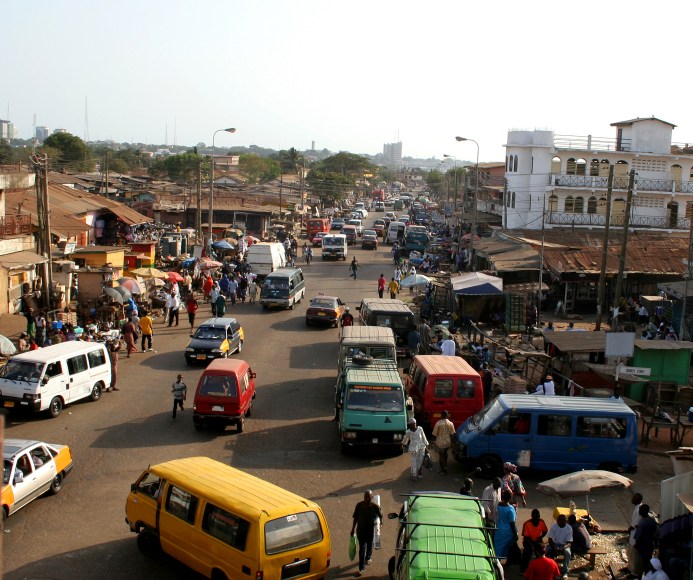
Open air markets – In many cases products flow from agents who sell directly to wholesalers or directly in open markets. In Nigeria open air markets (view pictures of Idumota market) remain the primary purchase channel for a number of product categories. An estimated 70 percent of all wholesalers and retailers are located in the traditional markets. Wholesalers sell to retailers in large quantities and at discounted prices. Small groceries often require an intermediary, such as a wholesaler, to break bulk. For example, on a market visit to Kaduna, Nigeria, we identified the ability to break bulk as one of the key value drivers for smaller distributors or wholesalers. Nearly all importers have outlets or representative wholesalers in open markets.
Feeder markets – Some markets also act as feeder markets. The coverage of the feeder town depends on product category, price and availability. It is estimated that 60% of consumer goods products flow through markets in Lagos, Kano, Maiduguri and Onitsha. In Accra, Ghana, I met retailers selling satellite dishes purchased from markets in Lagos, which they profited on even after factoring in the bus fare to collect the dishes. However, the retail landscape is changing quickly and open markets are in decline for certain product categories.
Distribution models – The majority of international brand owners operating in Nigeria use third-party distribution networks. A number of companies have developed direct distribution models or are actively managing their third-party distribution partners, e.g. Coca-Cola. Some companies, such as Coca-Cola, have also developed micro-distribution models (mini depots, push carts) to better service traditional trade channels (view picture of Coca-Cola distribution). Several B2B e-commerce start-ups, such as TradeDepot, Omnibiz and Alerzo, also deliver stock directly to small shops, although many have had to cut back since 2022.
Finding the right partners – Finding the right partner can be a challenging undertaking. Few distributors handle the “last mile” of logistics and most distributor footprints are limited to wholesale and key account outlets. A number of companies have opted for multiple distribution networks focused on geographic areas and types of customers, as there are few distributors with a national footprint.
Nigeria is a fast-changing environment. Modern trade and retailing are evolving, and consumers’ shopping patterns are changing as household budgets come under pressure. What works today will likely not work tomorrow. Take time to understand culture issues and don’t assume anything.

